
Best Python Frameworks for Web Development in 2023


As technology evolves unprecedentedly, Python remains at the forefront of the programming languages powering the web. Python’s versatility, readability, and extensive community support have made it a top choice for web developers worldwide.
But with so many Python frameworks available, choosing the right one for your project can be daunting.
Whether you have a ton of completed projects or are just starting your first startup and looking for a framework for your project, Python is here to help. It is a perfect choice for projects of any type as it helps you save time and effort and deliver awesome results.
This article will guide you to the best Python frameworks for web development in 2023 and explore the top contenders, such as Django, Micro-framework, Flask, CherryPy, Dash, and their unique features.
So, let’s dive into the exciting world of Python web development frameworks and find the perfect framework to supercharge your projects in 2023!
Popular Python Web Frameworks 2023
Let’s uncover the best Python web frameworks you can choose from:
Django
Features
Django is one of the most popular Python web frameworks. It is known for its comprehensive feature set, including a robust ORM (Object-Relational Mapping) system that simplifies database management. It offers an admin interface for content management, a secure authentication system, and built-in support for user management. Django also provides a powerful templating engine, URL routing, and a middleware system for extending functionality.
Use Cases
Django is best suited for building large-scale, data-driven web applications. It’s ideal for projects such as social media platforms, e-commerce websites, and content management systems due to its “batteries-included” approach, which accelerates development by providing pre-built solutions for common web development tasks.
Flask
Features
Flask is characterized by its minimalistic core, which includes routing, request handling, and a WSGI (Web Server Gateway Interface) development server. Flask’s simplicity allows developers to choose and integrate additional components as needed. It has an active ecosystem of extensions that add features like authentication, database integration, and more.
Use Cases
Flask is often preferred for smaller projects, RESTful APIs, and prototypes. Its simplicity and flexibility make it an excellent choice when you want fine-grained control over your application’s components and dependencies. Flask is particularly popular for microservices development.
Hug
Features
Hug is also among the top Python web frameworks. It was designed for creating APIs with minimal effort. It offers automatic input validation, automatic documentation generation, serialization support, and parameterized routing. Hug prioritizes simplicity and performance, making API development quick and efficient.
Use Cases
Hug is well-suited for projects that require rapid API development, such as mobile app backends, data sharing between services, or creating RESTful APIs for web applications. It simplifies the process of building and documenting APIs.
Bottle
Features
Bottle is an incredibly lightweight micro-framework that includes a basic templating engine, built-in routing, and simple request handling. It doesn’t require external dependencies and can be extended with additional functionality through plugins.
Use Cases
Bottle is often chosen for small web applications, simple APIs, or as a learning tool for Python web development. It’s a great choice when you need to create a basic web service quickly without the complexity of a larger framework.
CherryPy
Features
CherryPy enables developers to build web applications using an object-oriented approach. It provides tools for handling HTTP requests, includes a minimalist web server, and supports URL routing and sessions. CherryPy’s design encourages clean, object-oriented code.
Use Cases
CherryPy is suitable for projects that require a custom, object-oriented approach to web development. It’s an excellent choice when you want fine-grained control over the architecture of your application and need to create a custom web framework.
Dash
Features
Dash is tailor-made for creating interactive web applications for data visualization. It offers a component-based architecture and includes a wide range of pre-built components for creating charts, graphs, tables, and interactive elements. Dash also supports real-time updates, making it suitable for applications requiring live data.
Use Cases
Dash is widely used by data scientists, analysts, and business intelligence professionals to build interactive data visualization dashboards, real-time monitoring tools, and reporting applications. It’s a powerful choice for projects where data presentation and interactivity are key.
Falcon
Features
Falcon places a strong emphasis on performance and is optimized for building high-speed APIs. It provides features like request and response validation, middleware support, and efficient routing. Falcon is designed to handle high-concurrency and high-throughput workloads efficiently.
Use Cases
Falcon is an excellent choice when you need to build high-performance APIs for microservices, Internet of Things (IoT) applications, or other projects with demanding traffic and processing requirements. It’s well-suited for scenarios where API speed and efficiency are critical.
FastAPI
Features
FastAPI is a modern, high-performance web framework that is specifically designed for building APIs. It leverages Python-type hints to automatically validate and serialize data, which makes it easy to work with JSON and data models. FastAPI also includes automatic interactive documentation generation, WebSocket support, and asynchronous request handling.
Use Cases
FastAPI is ideal for developing APIs, whether it’s for a microservice architecture, a web application backend, or a data-driven project. Its focus on performance and type safety makes it a great choice for building robust, efficient APIs.
Tornado
Features
Tornado is an asynchronous networking library and web framework. It’s designed to handle high concurrency and is well-suited for applications requiring real-time features like WebSockets and long polling. Tornado also includes a simple web framework for building web applications.
Use Cases
Tornado is commonly used for real-time web applications, chat applications, and services that require high-performance, non-blocking I/O. It’s a strong choice for building scalable, event-driven applications.
TurboGears
Features
TurboGears is a full-stack web framework that integrates multiple libraries and tools to provide a complete web development solution. It includes an ORM (SQLAlchemy), a templating engine (Genshi), and a comprehensive set of tools for building web applications. TurboGears emphasizes rapid development and follows the convention-over-configuration (CoC) principle.
Use Cases
TurboGears is suitable for building complex web applications that require a full-stack framework. It’s a versatile choice for projects ranging from content management systems and e-commerce platforms to custom web applications.
Each Python web development framework offers unique features and advantages, allowing developers to choose the one that best aligns with their project’s requirements and development philosophy.
Why you should be Using Python Framework?
Python frameworks are an indispensable tool in modern web development, offering a structured and systematic approach that brings a multitude of benefits to developers and their projects. One of the foremost advantages is enhanced code organization, which significantly improves maintainability and fosters collaboration among team members.
By adhering to the conventions and best practices set by these frameworks, developers can work cohesively and build applications that are not only robust but also easier to maintain over time.
Efficiency is another compelling reason to embrace Python frameworks. They come equipped with a wide array of pre-built features and components that streamline common development tasks, saving developers valuable time and effort.
This means fewer lines of code need to be written, reducing the chances of introducing bugs and speeding up project delivery. Consequently, the need for repetitive coding is minimized, allowing developers to focus on the unique aspects of their applications.
Moreover, Python frameworks prioritize security. They often come with built-in security features, such as input validation and protection mechanisms against common web vulnerabilities like SQL injection and Cross-Site Scripting (XSS).
This proactive approach to security safeguards your application and its data and ensures a safer online environment for your users. In a world where cyber threats are ever-present, the security offered by Python frameworks is a compelling reason to incorporate them into your web development toolkit.
Choosing the Right Framework for Your Project
Factors to Consider When Selecting Web Frameworks for Python
Selecting the most suitable Python framework for your project is a pivotal decision that can profoundly impact your development process and the success of your application. Several key factors should be considered when making this critical choice:
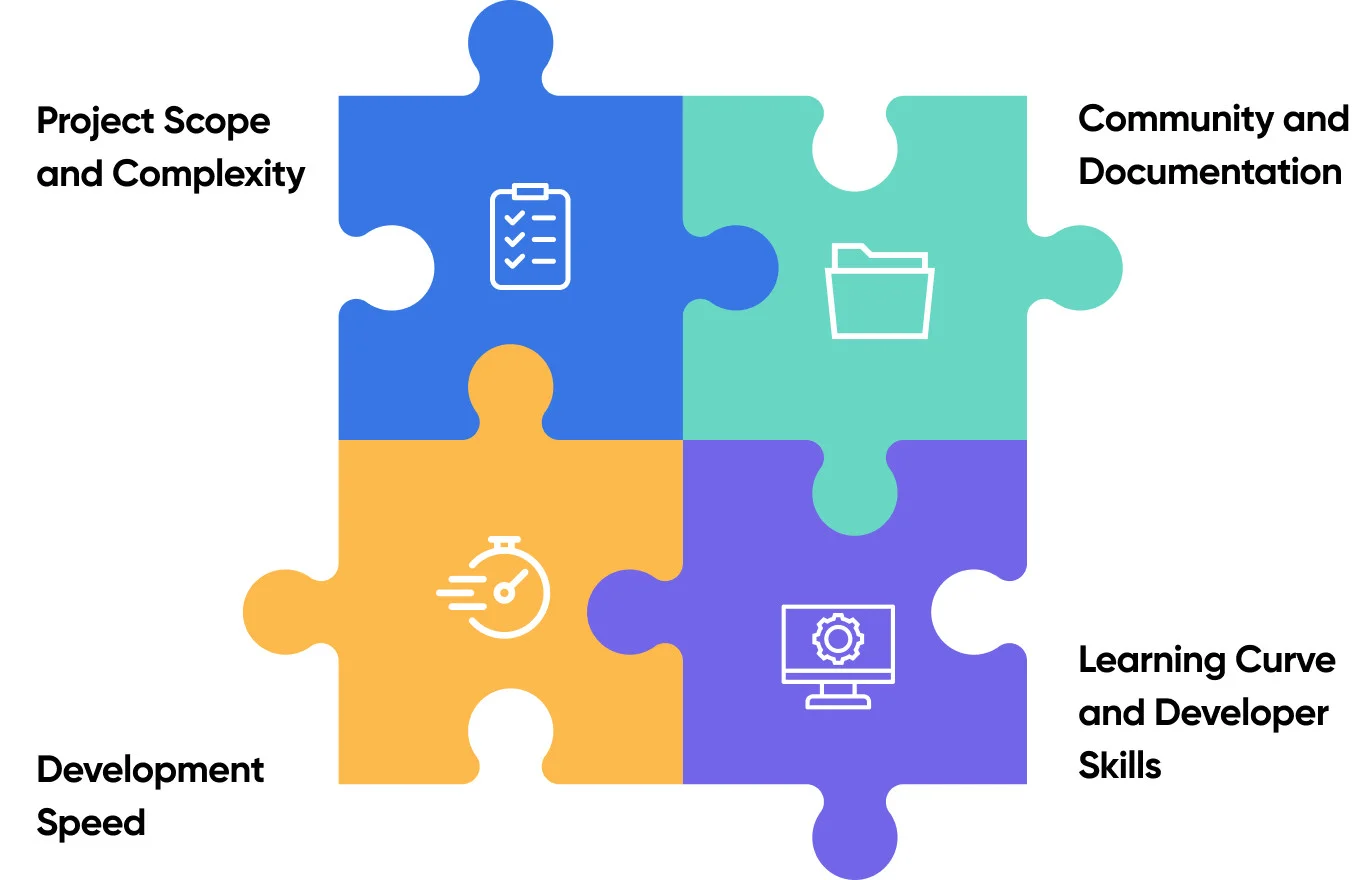
1. Project Scope and Complexity: The framework you choose should align with the scale and complexity of your project. While full-stack frameworks like Django offer a comprehensive set of features suitable for large-scale applications, micro-frameworks like Flask may be more appropriate for smaller projects. Opt for a framework that provides the necessary tools without introducing unnecessary overhead.
2. Development Speed: The timeline for delivering your project plays a crucial role in framework selection. If you need to rapidly prototype or develop a minimal viable product (MVP), micro-frameworks are often the preferred choice due to their simplicity and flexibility. Conversely, if your project demands a comprehensive feature set, a full-stack framework like Django might be better suited to handle the additional development time.
3. Community and Documentation: A thriving community and comprehensive documentation are invaluable assets when working with all web frameworks in Python. A strong community ensures that you can seek help, find resources, and access solutions to common problems. Well-documented frameworks simplify the learning process and troubleshooting, allowing developers to be more productive.
4. Learning Curve and Developer Skills: Consider your team’s existing expertise and the learning curve associated with the framework. Leveraging a framework that aligns with your team’s skills can expedite development and reduce the potential for errors. However, don’t shy away from exploring new frameworks if they offer substantial benefits for your project, as long as you account for the learning curve in your timeline.
By carefully assessing these factors, you can make an informed decision when selecting a Python framework that not only meets your project’s immediate needs but also positions it for success in the long term.
Comparative Analysis of Discussed Frameworks
| Framework | Main Features | Use Cases | Learning Curve | Project Complexity | Community & Documentation |
| Django | ORM, Authentication, Admin Interface | Large-scale apps, CMS, e-commerce | Moderate | High | Strong |
| Flask | Minimalistic, Flexible | Small to medium projects, RESTful APIs | Low | Low to Moderate | Strong |
| Hug | API-centric, Simplicity | Building APIs quickly, data sharing | Low | Low | Moderate |
| Bottle | Lightweight, Easy to use | Small projects, Prototyping, Learning | Low | Low | Limited |
| CherryPy | Object-Oriented, Fine-Grained | Custom web architectures, OOP | Moderate | Low to Moderate | Moderate |
| Dash | Data Visualization, Interactive | Data dashboards, Real-time apps | Moderate | Low to Moderate | Strong |
| Falcon | High-Performance APIs, Optimization | High-traffic APIs, Microservices | Moderate | Low to Moderate | Moderate |
| FastAPI | Type Hints, Automatic Validation | API development, Efficient APIs | Low to Moderate | Low to Moderate | Growing |
| Tornado | Asynchronous, Real-Time | Real-time applications, WebSocket | Moderate | Low to Moderate | Moderate |
| TurboGears | Full-Stack, Convention-Over-Config. | Complex web apps, Convention-based projects | Moderate to High | Moderate to High | Moderate |
Conclusion
In the vast realm of web development, the choice of a Python framework carries substantial weight.
As you embark on your web development adventure, remember that the framework you ultimately choose should be a harmonious fit with your project’s distinct requirements and your team’s existing skillset.
Whether you lean towards Django’s structured capabilities, Flask’s nimble simplicity, or one of the other frameworks discussed, the primary objective is to enhance your workflow.
In the ever-evolving landscape of web development, the key to sustained success lies in remaining informed and adaptable. Stay attuned to industry shifts and be ready to adjust your framework choice as needed.
Moreover, if you’re seeking a reliable development partner to bring your web project to life, consider reaching out to us. With our expertise and experience, we can provide valuable support and guidance in making the right framework choice and crafting your digital masterpiece with confidence and ease.
FAQ
Flask and Django are among the most popular Python web frameworks. Django is known for its all-inclusive features and conventions, while Flask is popular for its simplicity and flexibility.
At SoftFormance, we usually choose Django as a development framework. It is a high-level framework that follows the “batteries-included” philosophy, providing many built-in features like an ORM (Object-Relational Mapping), authentication, admin interface, and more. It promotes rapid development and follows the Model-View-Controller (MVC) architectural pattern.
Python web frameworks simplify web application development by providing a structured and organized way to build web applications. They abstract away low-level tasks, such as handling HTTP requests and database interactions, allowing developers to focus on application-specific logic. They also encourage code reuse through modular components like templates, models, and views.
Python web frameworks provide pre-built components and follow best practices, reducing development time, making it easier to maintain and scale applications over time, and reducing the risk of vulnerabilities in your applications.
Yes, Python web frameworks are suitable for both small-scale and large-scale web applications. Django, for example, is known for its scalability and is used by many large organizations for complex web projects.