
Django vs. Ruby on Rails: What to Choose and When?


I often compare the backend to the walls holding the house, and this is 100% true because no application will be sustained without a strong and flexible backend.
And when it comes to our favorite backend solution at SoftFormance, there is no rival to Django.
However, we also recognize Ruby on Rails as a very strong competitor to Django.
We already compared backend development technologies, namely Python and Node.js in one of our previous articles.
This time, we will compare Ruby on Rails vs Django. Keep reading to understand the strengths and the weaknesses of both software development technologies and find out which solution fits your needs better.
Pros and Cons of Django
Released in 2005, Django is a high-level Python web framework that simplifies web application development through its built-in tools.
Django provides a wide array of library solutions for tasks like database management, authentication, and URL routing to accelerate web development.
Its main advantages include:
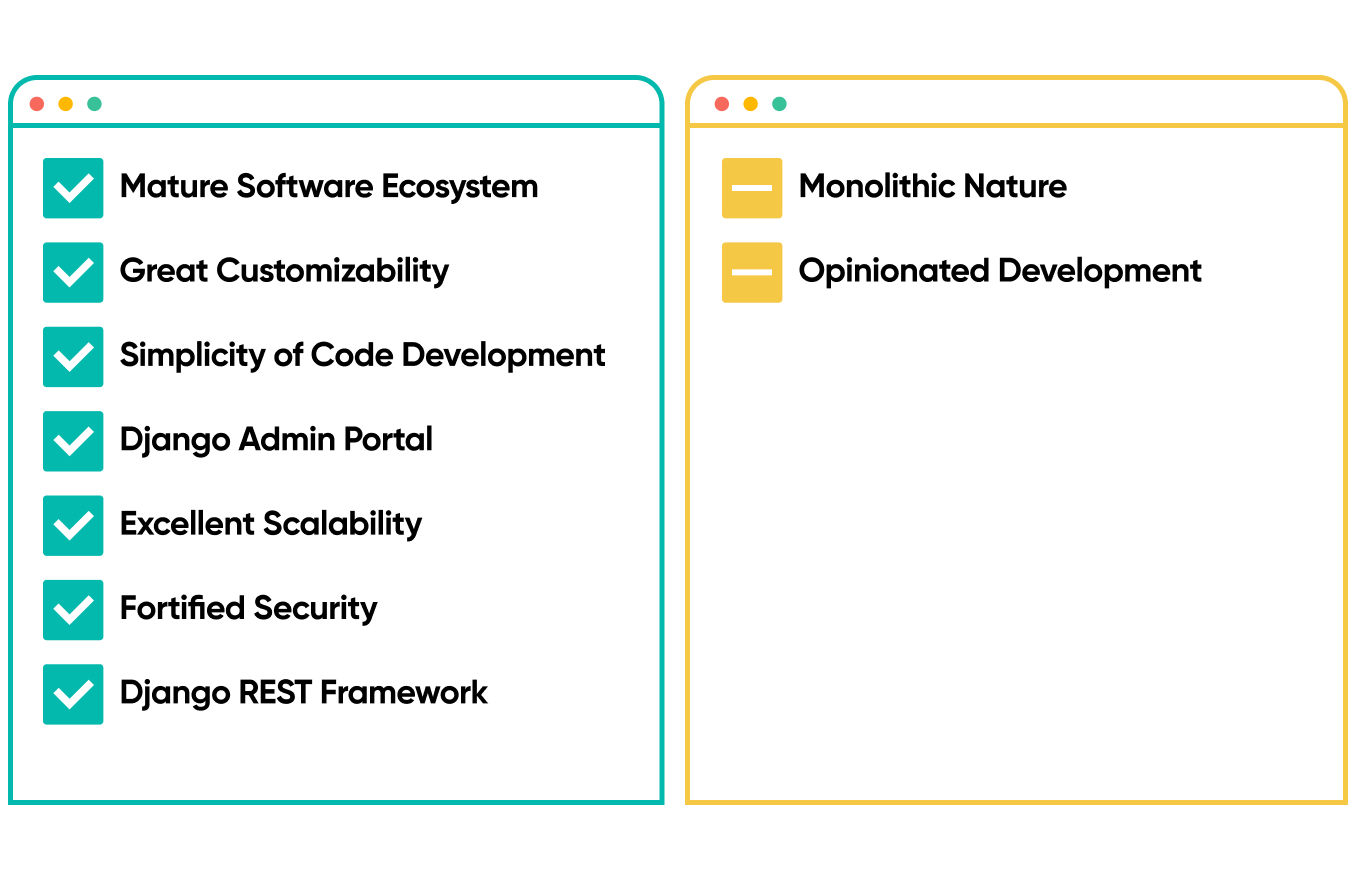
Mature Software Ecosystem
Django has been constantly developing since its release in 2005.
Enhanced with an impressive list of best practices and a vibrant community of developers, Django offers ready-to-go solutions that accelerate software development.
Besides, there is a very solid list of additional technologies that facilitate fast and efficient feature-centered Django development.
This list includes Cookiecutter Django, Django REST Framework, and many other tools and technologies used for diverse purposes.
Great Customizability
Django is highly customizable, providing developers with a solid list of business-specific features.
In particular, Django allows software engineers to swap the database, template, framework, and even object-related mapping (ORM) to deliver tailored solutions.
Django’s flexibility offers great opportunities for building custom middleware, template tags, and reusable app components.
It is important to note that all these customizations can be introduced without harming the app’s code quality.
Simplicity of Code Development
Python is a scripted language, which makes it one of the simplest backend development solutions in the market.
In fact, developing Python code vs. writing code in most other backend solutions is like driving an automatic vehicle engine vs. driving a mechanical one.
With its rich set of libraries and pre-configured patterns, Django makes Python development even less challenging.
These features enhance Django development speed and reduce the threat of costly code errors.
Django Admin Portal
Django offers its users a built-in admin panel, which significantly enhances Django code management.
In fact, Django offers developers a user-friendly and customizable portal allowing them to manage application data.
There are simple ways to configure database records, user accounts, and content without building a separate administrative interface from scratch.
Excellent Scalability
Django offers a component-based “shared-nothing” architecture, which contributes to its scalability.
According to this principle, each web request to the application is treated independently, and there is no shared state or memory between requests.
As a result, developers can scale their applications horizontally by deploying them across multiple servers or containers.
As long as there are no shared resources, there are much less bottlenecks with scaling.
Fortified Security
Django provides a wide array of solid security features that fortify digital solutions from cross-site forgery, cross-site scripting, and clickjacking.
In addition, this framework offers tools that help developers prevent SQL injections.
Other important Django features enhance session management, HTTPS usage, user authentication views, and many more.
All in all, Django was developed with regard to the growing cybersecurity threats, and the framework is excellent at dealing with them.
Django REST Framework
REST framework is a flexible toolkit helping Django developers create web APIs in the shortest terms possible.
This framework offers a set of tools and libraries for easily creating RESTful APIs with features like serialization, authentication, and view classes.
The framework also simplifies the process of designing, developing, and testing APIs in Django web applications.
These features make Django’s REST framework a very popular solution for achieving scalability and seamless security.
Meanwhile, the main disadvantages of Django are:
Monolithic Nature
As we have already mentioned, Django is a solution with many out-of-the-box features and capabilities. However, this benefit has a downside.
Django is monolithic by nature, which means that the framework pushes developers into certain patterns. Such a structure can be hard to manage for very big projects that need high customizability.
In particular, breaking down large applications into smaller microservices may be rather challenging with Django.
While all these challenges can be solved with the right skills, in specific cases, monolithic architecture becomes Django’s downside in comparison with some other backend technologies.
Opinionated Development
Some developers say that Django limits their creativity.
The point is that many configurations are predetermined due to its opinionated development principles.
Meanwhile, Django is all about reliability, while the right choice of Django libraries still creates a great space for being creative.
Pros and Cons of Ruby on Rails
Ruby on Rails, or simply Rails, is an open-source web application framework written in the Ruby programming language.
With its Model-View-Controller (MVC) architectural pattern, Ruby on Rails is a great solution for building robust and maintainable web applications.
Rails also provides a wide array of sensible default configurations that reduce the need for repetitive coding tasks.
Its main advantages include:
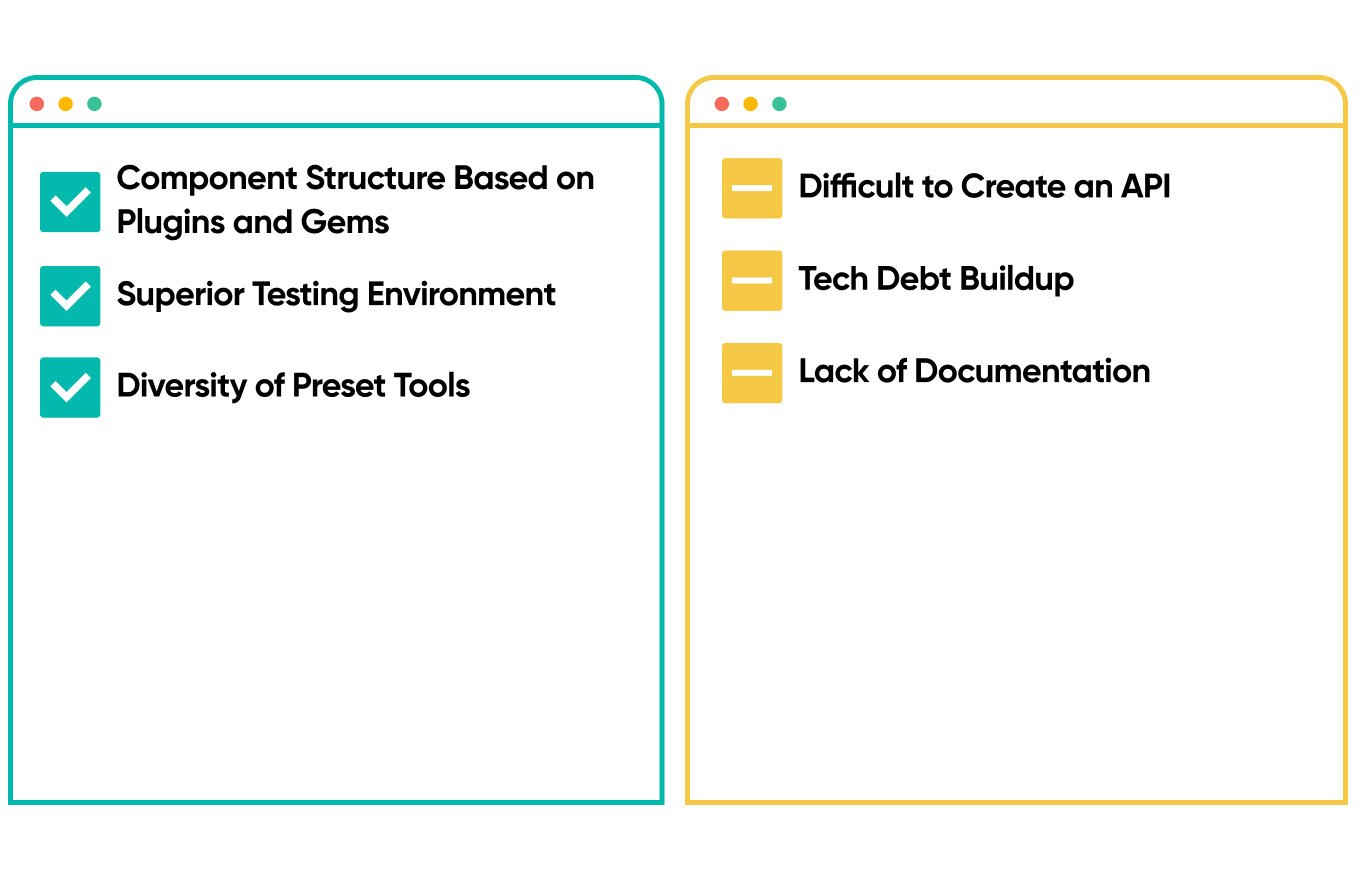
Component Structure Based on Plugins and Gems
Various ready-to-go components facilitate fast development with Rails.
Experienced RoR developers can use them to put together efficient applications with less coding in record terms.
It is important to note that Django offers a wide array of pre-developed components as well. However, the principles of their use differ in Django and RoR.
Superior Testing Environment
One of the main selling points of Ruby on Rails is its superior testing environment.
This environment includes built-in support for unit testing, integration testing, and functional testing.
In simple words, this environment provides for simple automated testing with the right frameworks.
This significantly boosts the speed of testing and helps RoR developers ensure the highest code quality.
Diversity of Preset Tools
Just like Django, Ruby on Rails offers a solid list of preset tools to software developers.
For example, the RoR ecosystem includes ActiveRecord. It is Rails’ built-in Object-Relational Mapping (ORM) framework, which simplifies database interactions.
As a result, the developers can work with databases using only Ruby code instead of SQL.
The main benefit of this feature is that it boosts the speed of development in small and simple projects.
Meanwhile, fast development for MVP projects is also a solid Django benefit.
So, in this regard, both technologies achieve the same benefit in different ways.
As for the disadvantages of Rails, they are the following:
Difficult to Create an API
I’ve already mentioned that Django is an excellent solution for building APIs with its REST framework.
Meanwhile, challenges in building APIs are often viewed as RoR’s most significant downside.
The framework doesn’t provide a solution for fast development of APIs.
Therefore, this framework may not be the best solution for developing apps that require integrations through APIs.
Tech Debt Buildup
RoR is very flexible and allows developers to compile completely different code fragments.
However, this flexibility also has its downside. Software engineers often face very striking code diversity while building apps with Ruby on Rails.
This, in turn, grows the code debt, which, eventually, has to be dealt with afterward.
Lack of Documentation
Surprisingly, finding documentation on some RoR best practices and tech solutions may be rather challenging.
Therefore, many developers without significant technology experience find it challenging to find the right documentation for RoR.
Mostly, they should work with a Ruby on Rails test suite.
Django vs Ruby on Rails: Analyzing Popularity
The popularity of a programming framework is one more important indicator of its relevance.
Recent studies show that 62% of web developers working with Django enjoy it.
Meanwhile, 57% of web developers working with RoR enjoy it.
It is also worth mentioning that 6% of developers working with Django expressed interest in it.
Meanwhile, for Ruby on Rails, this number reaches 4%.
So, we may certainly say that Django is more popular than Ruby on Rails, and it already means something.
Considering the pros and cons mentioned above, these numbers seem quite logical.
But it is impossible not to see that both frameworks still have much in common.
Similarities Between Django and Ruby on Rails
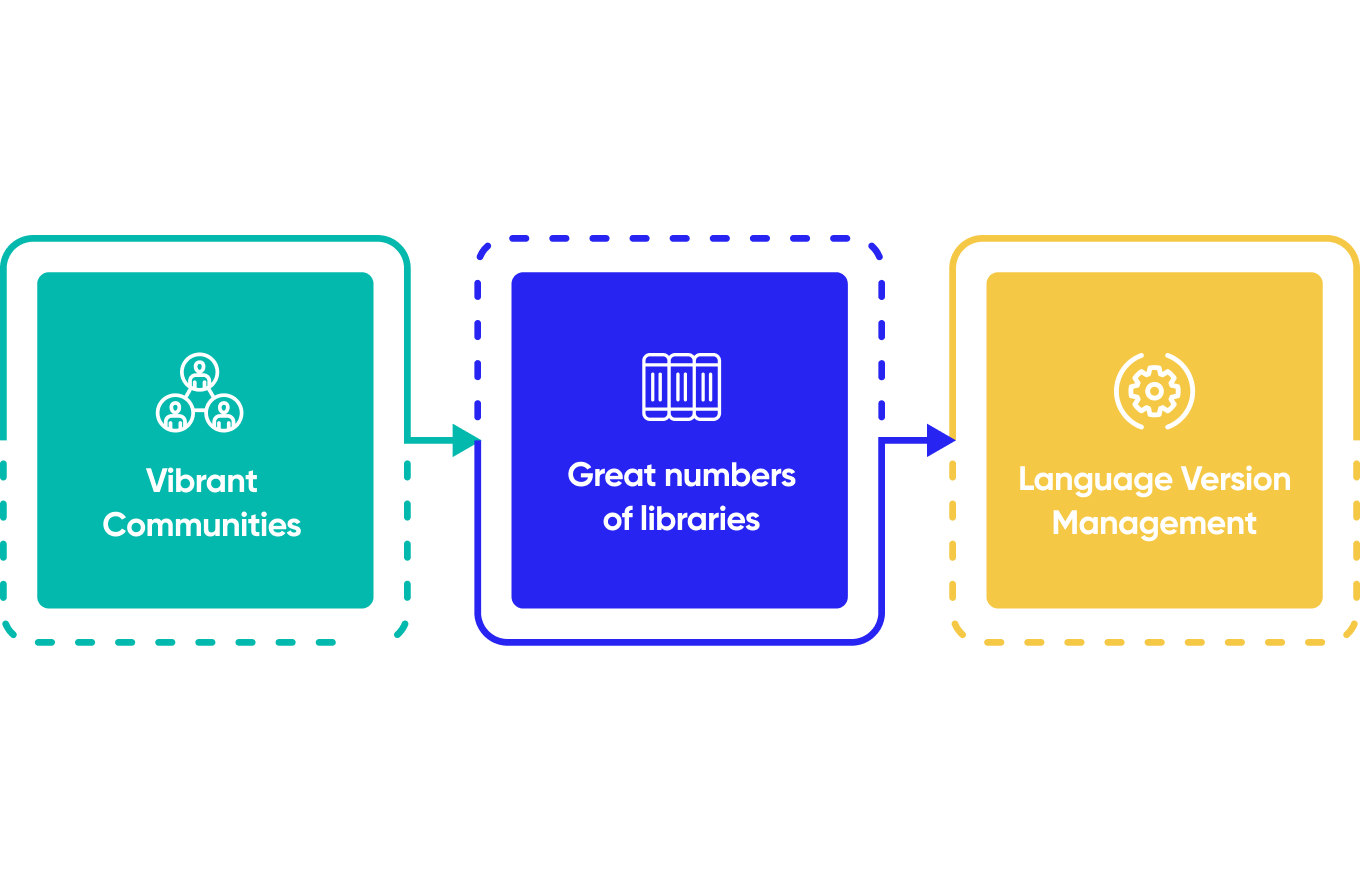
So, here are some common points between Django and Ruby on Rails that should be mentioned in the context of the Ruby on Rails vs. Python Django comparison:
Vibrant Communities
When it comes to Django vs Rails popularity, both frameworks have quite vibrant communities. Experienced Django and RoR developers have solid expertise in implementing solutions built with these technologies and are ready to share their experiences. Therefore, there are big lists of best development practices and tips.
Great numbers of libraries
Django and RoR libraries provide ready-to-go configurations, templates, and application parts. As a result, both solutions perfectly fit rapid software development with their pre-configured code parts.
Language Version Management
Environment control is another great feature common for both sides of the Python Django vs. Ruby Rails rivalry. It allows running many projects simultaneously. This similarity also contributes to fast software development with the two frameworks.
Differences Between Django and Ruby on Rails
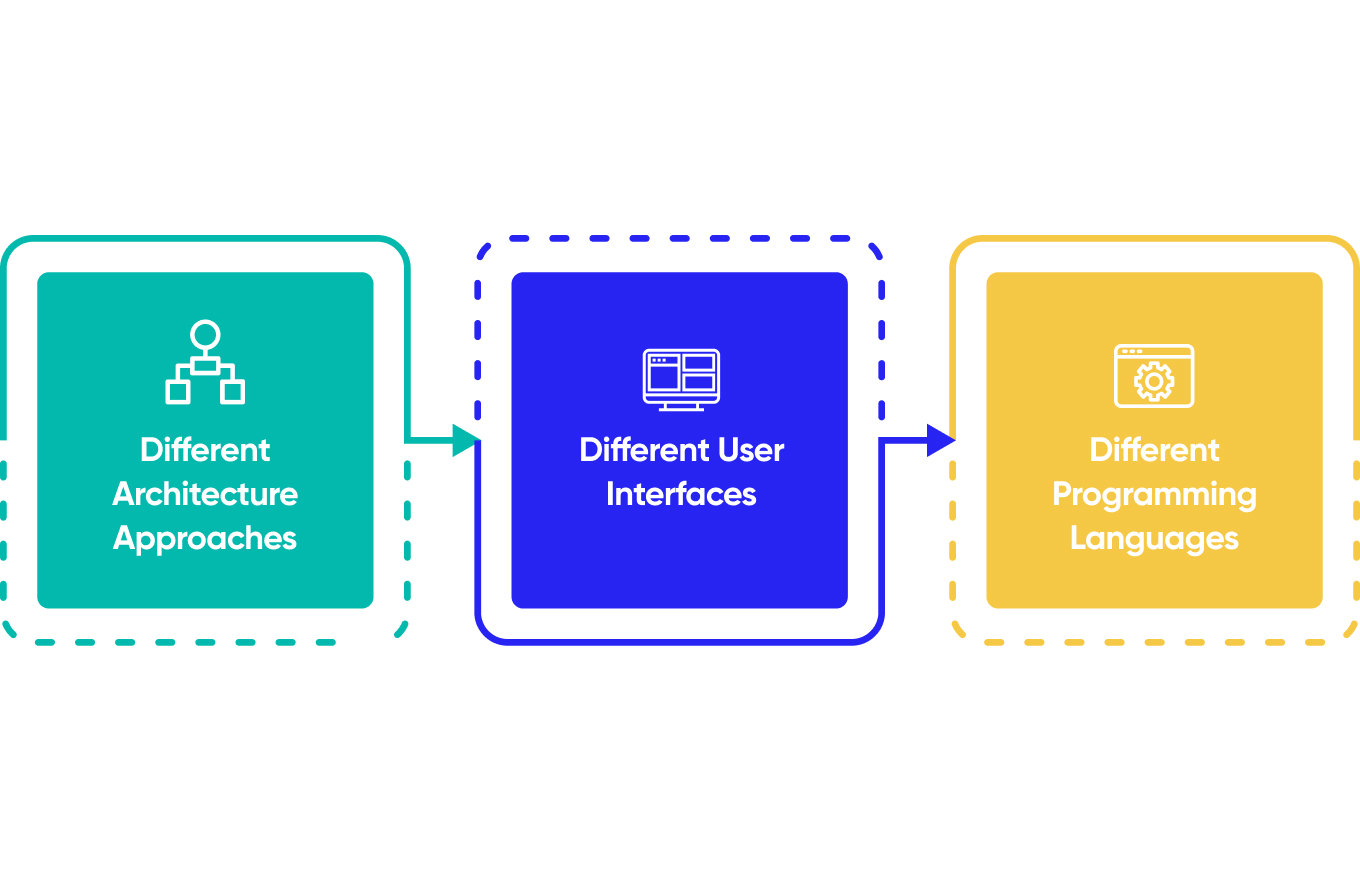
While having much in common, Django and Ruby on Rails still have many differences. These are the most valuable distinctions in terms of the Django vs. Ruby on Rails comparison:
Different Architecture Approaches
Django uses MVT or Model View Template architecture, while RoR follows MVC or Model View Controller architecture. The main difference between the two approaches lies in the fact that MVT emphasizes a cleaner separation between presentation and logic. This, potentially, leads to improved maintainability and easier collaboration between frontend and backend developers.
Different User Interfaces
The two tech solutions have quite different interfaces. Django is more straightforward. This feature may limit creativity, but it also ensures fast and reliable development. Meanwhile, RoR offers more space for developers’ creativity. That’s why its software development UI is more flexible than the one of Django.
Different Programming Languages
Django’s language, Python, and Ruby are both object-oriented languages. However, Python is a general-purpose language with syntax that facilitates the development of AI and ML components and has a much wider implementation due to its integration capabilities. Meanwhile, Ruby offers a variety of syntax constructs that are more restricted to web server development. Also, when it comes to Django vs. Rails performance, the former has some advantages. Such differences should be considered while deciding between Ruby on Rails or Django.
Choosing Between Django and Ruby on Rails: Making the Right Decision
As for the practical side, these are the tips on what choice to make while facing a Python Django vs. Ruby on Rails dilemma.
As a more dynamic framework that provides space for various integrations, Django is a perfect solution for apps with rapidly changing content and complex APIs.
It will be a perfect match if you need to develop:
- Dynamic digital marketplaces, such as Gryps
- Highly interactive travel and booking apps like ParkCommander
- Lab management systems with workflow management functionality for different user roles, like LifeChemicals
- Analytical platform, especially the one that leverages AI scripts, for example, DashPro.
Just like Django, Ruby on Rails puts emphasis on the fast development of applications. It fits MVP development projects and rather simple software solutions. However, the main focus of RoR is not on dynamic apps, but rather on CPU-intensive web apps with loads of content.
You may choose Rails if you want to build:
- Large-scale yet simple by-design content platforms, such as Goodreads
- More static e-commerce platforms with scarce interactivity.
Summary
All in all, Rails vs. Django comparison shows that both Django and Ruby on Rails are great technologies with ideal use cases.
However, we at SoftFormance are sure that in 95% of cases, the Python/Django combination is a better choice because it has a broader implementation.
Almost everything that can be done with Ruby on Rails can be built with Django, and, in many cases, better.
So, in most situations, there’s just no reason to opt for RoR while facing the Django vs. Rails dilemma.
Besides, Django is more popular than RoR, which means that there are many more Django development resources.
And don’t forget about the many benefits of AI that may be embraced with Django.
So, we at SoftFormance recommend Django when you are facing the Django or Ruby on Rails dilemma. And if you want to leverage this great technology, contact us, and let’s build your dream app together.
FAQ
Both technologies offer great scalability, but Django, with its advanced vertical scaling, might provide a better experience than RoR.
Both frameworks have vibrant and very dynamic communities, but the community of Django developers is slightly bigger than the one of RoR developers.
Django’s REST framework offers great opportunities for building excellent APIs. Meanwhile, challenges with API development and integration are among RoR’s biggest downsides.